
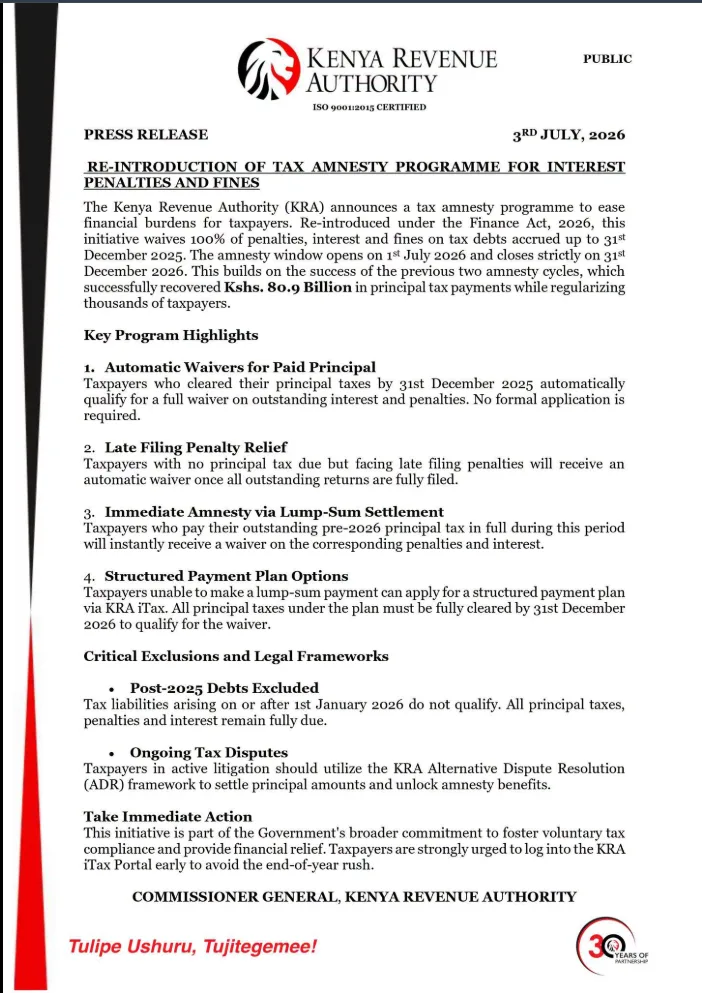
The Kenya Revenue Authority (KRA) has officially reintroduced the Tax Amnesty Programme through a public press release dated 3rd July 2026. The programme opens on 1st July 2026 and runs until 31st December 2026, allowing qualifying taxpayers to obtain a 100% waiver of penalties, interest, and fines on eligible historical tax debts.
This announcement converts what had previously been a Finance Bill proposal into an operational tax relief programme. Businesses can now begin taking action through the KRA iTax system.
Frequently Asked Questions On KRA TAX Amensty
Only in specific cases — where principal tax was already paid by 31st December 2025, or where all outstanding returns are filed and no principal is owed. Everyone else needs to apply, pay, or arrange a payment plan.
If you fall under the automatic waiver categories, no. If you still owe principal tax, yes — either through the lump-sum route or a structured payment plan application.
Yes. KRA’s structured payment plan option allows instalments, provided the full principal is cleared by 31st December 2026.
Full penalties and interest are reinstated on any remaining balance, and the relief is lost for that liability.
Yes, VAT penalties and interest accrued before 31st December 2025 are covered, subject to the same principal-tax conditions.
Yes, PAYE penalties and interest are covered under the same rules.
Yes, turnover tax penalties fall within scope as well
If your case involves an active dispute, KRA directs taxpayers to the Alternative Dispute Resolution (ADR) framework to settle the principal and unlock amnesty benefits. Cases involving fraud or Section 85 avoidance penalties are excluded outright.
Looking for the complete guide? Read our Kenya Tax Amnesty 2026 Guide, where we explain eligibility, payment plans, automatic waivers, exclusions and savings examples.
What Has Changed Since the Finance Bill?
For months, the amnesty extension existed only as a proposal inside the Finance Bill 2026. That proposal has now been enacted under the Finance Act, 2026, and KRA has issued formal operational guidance confirming exactly how it will work.
| Finance Bill Proposal | KRA Announcement |
|---|---|
| Proposed extension | Programme officially launched |
| Awaiting assent | Active from 1st July 2026 |
| Payment plans proposed | Payment plans confirmed |
| Expected waivers | Automatic waivers confirmed |
| Draft provisions | Operational guidance issued |
In short: the guesswork is over. Taxpayers no longer need to plan around a bill that “might” pass — they can act on a live, government-confirmed programme with a fixed closing date.
Key Highlights from the KRA Announcement
1. Automatic Waiver for Paid Principal Tax
Taxpayers who had already cleared their principal tax by 31st December 2025 qualify for an automatic waiver of the outstanding interest and penalties attached to that debt — no formal application is required.
Who qualifies: Anyone whose principal tax balance for periods up to December 2025 was fully settled, even if penalties and interest remained outstanding.
What happens automatically: KRA will reconcile iTax records and clear the interest and penalty balance without the taxpayer needing to lodge a request.
Is an application needed? No — this is the one category in the entire programme that does not require a formal application, commitment letter, or payment plan.
Why this matters: Many businesses assumed that because they still had penalties showing on their iTax ledger, they were excluded from relief. This clause specifically protects taxpayers who did the right thing (paid the actual tax owed) but were still carrying the interest that had piled up before payment.
Potential practical issues: Reconciliation depends on KRA’s system correctly matching historical payments to the right tax obligation. Taxpayers should still log into iTax and confirm the waiver has actually been applied, rather than assuming it will happen instantly or without error.
2. Automatic Relief for Late Filing Penalties
This is one of the least understood parts of the programme, and one that very few taxpayers realise applies to them.
Many taxpayers have no outstanding principal tax at all — but have accumulated late filing penalties after failing to submit VAT, PAYE, or NIL returns on time. KRA has confirmed that these taxpayers may also receive automatic waivers, but only once all outstanding returns are actually filed.
This matters because late filing penalties can quietly accumulate over years, even when a business owes little or no actual tax. A sole trader who forgot to file a handful of NIL VAT returns, for example, could be sitting on tens of thousands of shillings in penalties despite never having under-declared or underpaid a single shilling in tax. Under this clause, filing the missing returns is the trigger — once the backlog is cleared, the penalty waiver follows automatically.
The practical implication is significant: taxpayers in this category should treat “file every outstanding return” as their single most urgent action this month, since the waiver cannot activate on penalties attached to periods that are still unfiled.
3. Lump Sum Settlement Option
Taxpayers who pay their outstanding pre-2026 principal tax in full during the amnesty window receive an instant waiver on the corresponding penalties and interest.
Benefits: This is the fastest, cleanest route through the programme — no repayment schedule to manage, no ongoing compliance risk over an 18-month plan, and immediate closure of the historical liability.
Cash flow implications: Businesses need to weigh the upfront cost of clearing principal in one go against the savings on penalties and interest. For debts that have been outstanding for two or three years, the accumulated interest alone can represent a large share of the total bill, so the lump sum option often makes strong financial sense if the cash is available.
Who should use it: Businesses with the liquidity to clear their principal now, and those who want to avoid the administrative overhead of a multi-month payment plan and the risk of defaulting on it.
4. Structured Payment Plans
Taxpayers unable to make a lump-sum payment can apply for a structured payment plan via KRA iTax, provided all principal tax under the plan is fully cleared by 31st December 2026.
How repayment plans usually work: The taxpayer proposes a schedule of instalments that clears the outstanding principal before the deadline, and KRA assesses whether the plan is realistic based on the taxpayer’s history and declared cash flow.
When businesses should use them: When the principal balance is too large to settle immediately, but the business has predictable revenue that can support scheduled instalments over the remaining months of 2026.
What documentation is likely needed: Expect to provide a liability breakdown by tax head, a proposed repayment schedule, and possibly supporting financial records demonstrating the plan is achievable.
Common mistakes: The two most frequent errors are proposing a schedule the business cannot realistically sustain, and failing to stay current on 2026 obligations while repaying historical debt — either of which can put the waiver at risk.
Who Qualifies Under the New Amnesty?
- Debt accrued before 31st December 2025
- Principal tax must eventually be cleared in full
- All outstanding returns filed
- Payment completed before 31st December 2026
- Structured payment agreement in place, where applicable
What Debts Are Excluded?
Not every liability is covered by the amnesty. The following fall outside the programme:
Post-January 2026 liabilities — Any tax debt arising on or after 1st January 2026 carries full penalties and interest, with no amnesty relief. Clearing historical debt does not give a business a clean slate on current obligations.
Section 85 penalties — Penalties imposed under Section 85 of the Tax Procedures Act, which relate to deliberate tax avoidance, are excluded. Late filing is treated as non-compliance; structured schemes designed to reduce tax owed are treated as avoidance, and the two are not judged the same way.
Tax fraud — Cases assessed by KRA as fraudulent are excluded outright and fall outside any amnesty protection.
Current obligations — Ongoing compliance (current PAYE, VAT, and other filings) must continue throughout the amnesty period; the programme is relief on historical debt, not a pause on present-day duties.
Interest after 2026 — Interest accruing from 1st January 2026 onward on any remaining balance is not waived.
Ongoing disputes — Taxpayers in active litigation over a tax matter should pursue KRA’s Alternative Dispute Resolution (ADR) framework to settle the principal amount and unlock amnesty benefits on the associated penalties and interest.
What Businesses Should Do This Month
Step 1 — Review your tax ledger. Log into iTax and pull a full liability statement across every tax head — PAYE, VAT, corporate income tax, turnover tax, and instalment tax.
Step 2 — Identify principal tax separately. Separate the figures into principal, penalties, and interest so you know exactly what must be paid to qualify.
Step 3 — Clear outstanding returns. File every missing return, including NIL returns, since unfiled periods block access to the waiver.
Step 4 — Determine whether payment in full is possible. If the cash is available, settling principal in full is the fastest route to relief.
Step 5 — Request a payment arrangement if necessary. If full payment isn’t feasible, prepare a realistic, executable repayment schedule before applying.
Step 6 — Monitor waiver application. Don’t assume relief has been applied automatically — check your iTax account to confirm the waiver has actually gone through.
Timeline
| Date | Event |
|---|---|
| March 2026 | Finance Bill proposes amnesty extension |
| June 2026 | Finance Act enacted |
| 3rd July 2026 | KRA issues official press release |
| 1st July – 31st December 2026 | Amnesty application window |
| 31st December 2026 | Final deadline |
What This Means for SMEs
Beyond the immediate savings on penalties and interest, this programme has knock-on effects that matter more to many SMEs than the waiver itself.
Cash flow — Clearing historical debt (or getting onto a structured plan) frees up cash that would otherwise be tied down by looming enforcement action or accumulating interest.
Loan applications — Lenders routinely check KRA compliance status. A business bogged down by historical arrears may struggle to secure financing regardless of how strong its current trading looks.
Government tenders — A valid tax compliance certificate is typically a prerequisite for bidding on public contracts. Businesses locked out of compliance certificates due to old KRA debt have effectively been locked out of an entire revenue channel — this amnesty is a route back in.
Tax compliance certificates — Clearing or arranging historical debt is often the single blocker preventing a certificate from being issued.
Director liability — Directors who have personally received liability notices over company tax debts have a direct interest in resolving the underlying company arrears before the window closes.
Future audits — Regularising historical periods now reduces the risk of those same periods surfacing as issues in a future KRA audit.
Expert Analysis
Although KRA describes the programme as a reintroduction, the operational framework now places much greater emphasis on voluntary compliance rather than blanket relief. Automatic waivers for qualifying taxpayers reduce administrative friction, while structured payment plans recognise that many SMEs remain cash constrained. Businesses should nevertheless treat the 31st December 2026 deadline as absolute: this is the third amnesty cycle KRA has run, and the programme’s framing continues to point toward this being the final window of its kind for historical liabilities.
It’s also worth noting KRA’s own figures on this programme’s track record — the previous two amnesty cycles recovered Kshs. 80.9 billion in principal tax payments while regularising thousands of taxpayers. That scale of recovery is likely part of why the government has chosen to run the programme again rather than move straight to stricter enforcement.
Final Thoughts
The July 2026 press release turns a proposal into action: qualifying taxpayers can now access a 100% waiver on penalties, interest, and fines for pre-2026 tax debt, provided principal is cleared — either in full or through an approved payment plan — by 31st December 2026. The categories that qualify automatically are generous, but everyone else needs to move now: file outstanding returns, reconcile your ledger, and decide between a lump-sum settlement or a structured plan before the window closes.
If you need a complete explanation of qualification requirements, repayment plans, exclusions, and savings calculations, read our comprehensive Kenya Tax Amnesty 2026 guide.
Leave a Reply