

The Kenya Tax Amnesty Programme is now officially in force following the enactment of the Finance Act, 2026 and the Kenya Revenue Authority’s implementation guidelines issued in July 2026. Qualifying taxpayers now have until 31 December 2026 to clear historical principal tax and obtain a 100% waiver of eligible penalties, interest and fines.
Unlike earlier drafts of the law, this is no longer a proposal. Businesses and individuals can now apply through KRA’s iTax system, either by paying outstanding principal tax in full or through an approved payment arrangement where applicable.
This guide explains exactly who qualifies, what debts are covered, how payment plans work, common mistakes that can disqualify taxpayers, and the practical steps you should take before the programme closes.
What Is the Kenya Tax Amnesty 2026?
The amnesty is a government programme under Section 37E of the Tax Procedures Act, proposed for amendment through the Finance Bill 2026. It allows qualifying taxpayers to have penalties and interest on historical tax debts fully waived — provided they settle all outstanding principal tax by December 31, 2026.
The proposal was tabled by Treasury CS John Mbadi before the Budget and Appropriations Committee of the National Assembly on March 26, 2026, and extends the original amnesty window that closed December 31, 2025.
Who Qualifies for the Tax Amnesty
Not every taxpayer with arrears automatically qualifies. All five conditions below must be met:
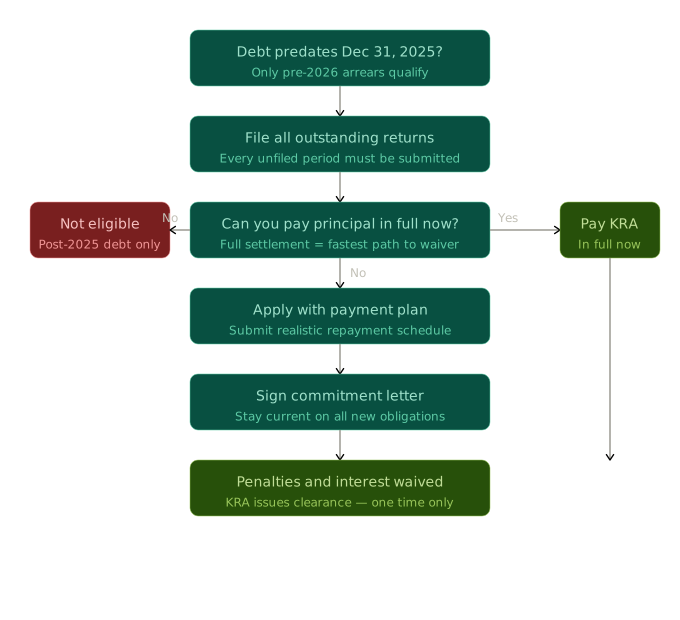
1. Your debt must predate December 31, 2025 The amnesty covers penalties and interest that accumulated up to December 31, 2025 only. Debt accrued from January 1, 2026 onward is not covered.
2. You must fully settle all principal tax The waiver applies only to penalties and interest — the underlying tax owed must be paid in full. Partial payment of principal does not unlock a partial waiver.
3. You must not accumulate fresh tax debt during the repayment period If you are on a payment plan for historical arrears and simultaneously miss current PAYE, VAT, or other obligations, your amnesty protection is at risk. Ongoing compliance is a condition of the relief, not an afterthought.
4. You must submit a commitment letter to KRA Applicants who cannot pay the full principal immediately must apply for amnesty and submit a formal, signed commitment letter agreeing to settle all outstanding taxes within the timeline.
5. You must submit a payment plan (if applicable) Taxpayers who had not fully paid their principal taxes by end of 2025 must apply and provide a structured repayment schedule to KRA. This plan must be realistic — a defaulted commitment removes your amnesty protection.
If you are unsure which category your situation falls into, professional advice before filing is essential.
Here is a visual summary of how the amnesty qualification process works:
What the Amnesty Actually Covers — And What It Does Not
Understanding the scope prevents costly assumptions.
Covered: All penalties and interest accumulated on tax debts that arose before December 31, 2025 — including PAYE penalties, VAT late filing penalties, corporate income tax surcharges, turnover tax penalties, and monthly interest charges on outstanding balances.
Not covered — the Section 85 exclusion: The Finance Bill 2026 explicitly excludes penalties imposed under Section 85 of the Tax Procedures Act. These are tax avoidance penalties, charged at double the amount of tax avoided. If KRA has assessed your case as deliberate tax avoidance this amnesty does not protect you. The distinction matters: late filing is non-compliance; structured schemes to reduce tax owed are avoidance. If you are unsure which category your situation falls into, professional advice before filing is essential.
Not covered — post-2025 principal tax: Any tax debt that arose from January 2026 onward carries full penalties and interest with no amnesty relief. Clearing your historical debt does not give you a clean slate on current obligations.
The “One Time Only” Clause — Why This Is the Final Window
The amended Tax Procedures Act states that the amnesty will be granted once only to qualifying taxpayers who meet all conditions. There is no suggestion of a further extension beyond December 31, 2026.
For context: Kenya’s first tax amnesty ran to December 31, 2025. The Finance Bill 2026 extension was motivated by the volume of businesses that had principal debt but insufficient cash flow to settle in full by the original deadline. The payment plan provision was added specifically to make this final window accessible to more businesses.
Once this window closes:
- All principal tax remaining unpaid after December 31, 2026 will attract the full penalty and interest regime
- No further amnesty will be available under this legislation
- Taxpayers who missed both windows will face standard enforcement with no relief pathway
How Much Could You Actually Save?
The amnesty’s financial value depends on how long your debt has been outstanding and how much has accumulated in penalties and interest relative to your principal. Here is an illustration using common SME scenarios:
Scenario A — Small PAYE arrears (8 months outstanding)
- Principal tax: KSh 80,000
- Late filing penalty: KSh 10,000
- Late payment penalty: KSh 4,000
- Monthly interest (8 months × 1%): KSh 6,400
- Total bill without amnesty: KSh 100,400
- Amnesty saving: KSh 20,400 (20% of total)
Scenario B — Corporate tax arrears (2 years outstanding)
- Principal tax: KSh 500,000
- Late filing penalty: KSh 25,000
- Late payment penalty: KSh 25,000
- Monthly interest (24 months × 1%): KSh 120,000
- Total bill without amnesty: KSh 670,000
- Amnesty saving: KSh 170,000 (25% of total)
Scenario C — Multiple tax heads, 3 years outstanding
- Principal tax (PAYE + VAT + CIT): KSh 1,200,000
- Combined penalties: KSh 130,000
- Accumulated interest (36 months): KSh 432,000
- Total bill without amnesty: KSh 1,762,000
- Amnesty saving: KSh 562,000 (32% of total)
The longer the debt has been outstanding, the more disproportionate the saving — because interest compounds monthly on every unpaid balance.
Your Step-by-Step Action Plan
Step 1 — Calculate your exact principal liability (this week) Log into KRA’s iTax portal and pull a liability statement across all tax heads: PAYE, VAT, corporate income tax, turnover tax, and instalment tax. Separate the figures into principal, penalties, and interest. The principal figure is what you must pay to qualify.
Step 2 — File every outstanding return immediately You cannot access the amnesty with unfiled periods sitting on your record. File all outstanding returns before your amnesty application — including NIL returns for periods with zero activity. Filing an estimated return now and amending later is better than waiting for perfect records.
Step 3 — Determine if you can pay in full or need a plan If you can pay the full principal: do so and file for the waiver immediately. If you cannot: prepare a realistic repayment schedule showing how you will clear the principal before December 31, 2026. KRA will assess whether the plan is credible — a plan you cannot execute is worse than no plan.
Step 4 — Submit your amnesty application with the commitment letter The commitment letter is a binding legal document. Have it reviewed before signing. It must specify the repayment amounts and timing, and your obligation to maintain current compliance throughout the period.
Step 5 — Stay current on all 2026 obligations This is where most businesses lose amnesty protection mid-process. While you are on a historical debt repayment plan, every PAYE return must be filed by the 9th, every VAT return by the 20th, and every instalment tax on its quarterly due date. One missed current obligation can void the arrangement.
Critical Deadlines at a Glance
| Milestone | Deadline | Consequence of Missing |
|---|---|---|
| File all outstanding returns | As early as possible | Cannot apply for amnesty |
| Submit amnesty application + commitment letter | Well before Dec 31, 2026 | Processing time reduces your window |
| Full principal payment (or plan completion) | December 31, 2026 | Full penalties and interest reinstated |
| Ongoing monthly compliance | 9th and 20th each month | Amnesty protection voided |
Important Caveat: Legislative Status
As of the time of writing, the tax amnesty extension to December 31, 2026 is a Finance Bill 2026 proposal — it must pass through the National Assembly and receive presidential assent before it becomes enforceable law. The Finance Bill is typically debated and passed mid-year.
This does not mean you should wait. Filing outstanding returns now, calculating your liability, and preparing your repayment plan costs nothing and positions you to act the moment the Bill is enacted. Businesses that wait until the Bill passes before preparing will have significantly less runway.
Monitor the Finance Bill 2026 progress through the National Assembly or work with a registered tax agent who will track enactment on your behalf.
Who Should Act Immediately
This amnesty is most valuable for:

We’re here to guide you.
You don’t have to navigate it alone
- Businesses with multiple years of unfiled PAYE, VAT, or corporate tax returns
- SMEs that received demand notices during 2024–2025 but could not pay in full
- Sole proprietors and partnerships with accumulated turnover tax arrears
- Companies that have been locked out of compliance certificates and government tenders due to outstanding KRA debt
- Directors who have received personal liability notices for company tax debts
If your business falls into any of these categories, the combination of penalty and interest waiver alongside a structured payment plan is the most comprehensive tax relief that has ever been legislated in Kenya. The window is fixed. The conditions are strict. The reward is substantial.
Leave a Reply